Showing posts with label The Atlantic. Show all posts

Tuesday, June 27, 2017

My brain is hanging upside down

For the July/August issue of The Atlantic: having power, being in charge, can have the same effects as a traumatic brain injury; causing the person to act "more impulsive, less risk-aware, and, crucially, less adept at seeing things from other people's point of view."


Thank you to my AD on this, Paul!


Monday, September 26, 2016

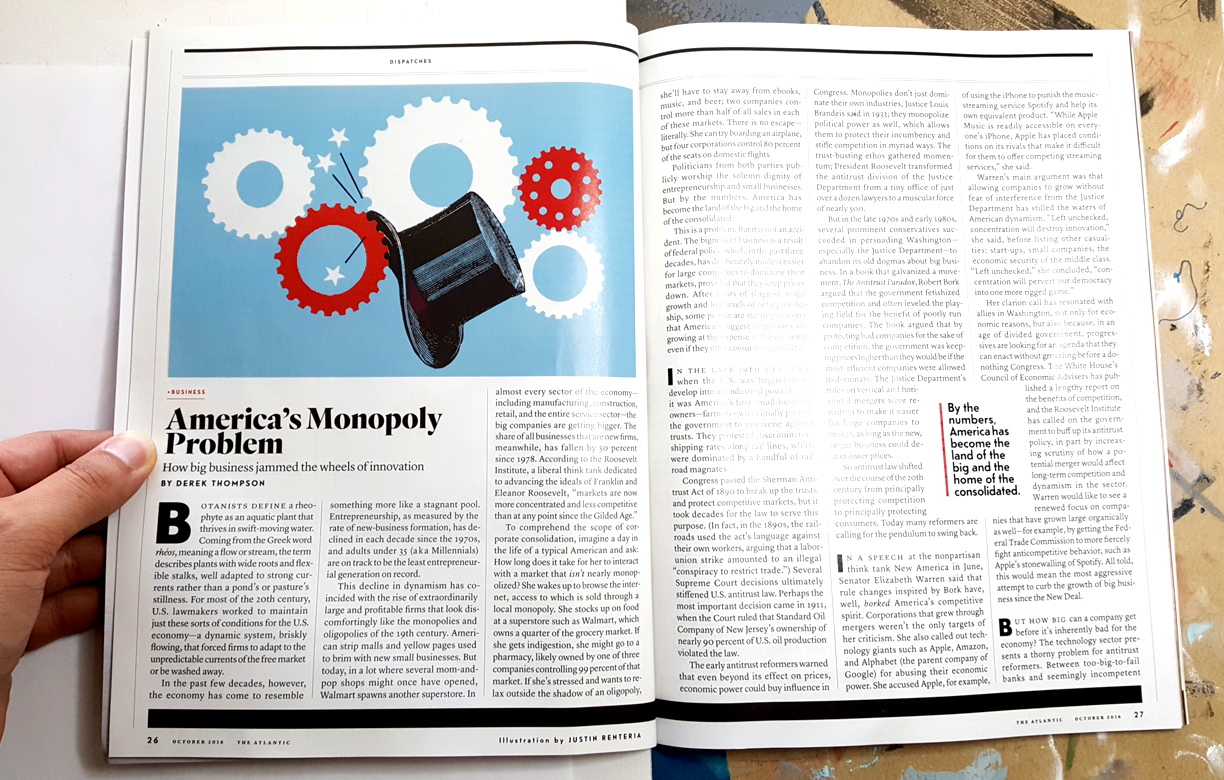
Know what really grinds my gears?

Out now in the current issue of The Atlantic is my piece for an article on the state of the U.S. economy, especially with regard to innovation and new business creation. Hint: it's not great. Why? Because we have a pretty serious monopoly problem in this country, that is looking increasingly like the gilded age of the late 19th century. As the article explains, nearly every industry is concentrated into a few humongous corporations that control a vast majority of the market in their respective sectors. Whether it's clothing, health insurance, airlines, cable, supermarkets, publishing- you name it- it's an oligopoly.


Pick up a copy, or read the article here. Thanks to, Paul!


Tuesday, May 24, 2016

It's Electric! Boogie woogie woogie.

The current issue of The Atlantic (yes, the one with Trump's giant head on the cover) is out, and includes a piece I did for an article on a hypothetical national electrical grid. One that can transport energy long distances, across the country:


The article points out the vulnerability of certain natural energy sources like wind and solar: the fact that the sun isn't always shining, and the wind isn't always blowing where a given population needs it to. But it's always sunny or windy somewhere. And if we had a national power grid to transport solar energy from a sunny Texas, to a gloomy Maine, those vulnerabilities disappear. It would be a big project, similar to Eisenhower's national interstate highway system. But it's possible, and very necessary, if we want to keep our world inhabitable. It's a great subject, and I had a bunch of fun creating this U.S.-shaped wiring diagram.


 And going back to Trump, check out the issue to see some great editorial design work. The Trump feature (subject notwithstanding) looks great.


Look at that portrait! For anyone not familiar with editorial design, the middle of the magazine spread where the pages meet is called the "gutter." How fitting. There are some things possible only in print, that digital editions, and websites just can't replicate. Not sure if one particular person is solely responsible for the design on this feature, but the team includes CD Darhil Crooks, AD Paul Spella, and designer Kara Gordon. They put together a great looking issue, and I'm proud to be a part of it.

Thursday, April 28, 2016

True grit

The new issue of The Atlantic is out, and features this piece of mine, for an article asking if "dogged, single-minded persistence" is always a good thing.


The article is centered around a forthcoming book by psychologist Angela Duckworth, titled Grit, where she argues that experiencing setback after setback can be beneficial in education as well as the professional realm. Overcoming these setbacks helps to strengthen one's resolve. And Duckworth found that some of the most successful people have gotten where they are due to their handling of setbacks and obstacles. This may seem self-evident, but the article questions, with the precarious nature of work these days, and how some industries appear and vanish with the trends, is it always a good idea to keep your nose to the grindstone? Is it sometimes better to give up, and try something else?


Thank you to Paul, my AD on this. Grab a copy and check out the story, or find it online here.


Monday, March 21, 2016

Fresh 'n Green!

This half page I did for The Atlantic is out now. It concerns the potential for a deluge of marijuana ads on the scale of beer ads we experience currently, now that many states have legalized it, with many more possibly to follow. The article explains that due to farming advancements, growing the product has become cheaper, and it may soon become a commodity, complete with the marketing schemes of any other commodity.

Living in a state where recreational use is perfectly legal for adults 21 and up, I've already seen some of the products out there. From cheeba chews to sativa sarsaparilla, you can find just about any edible to suit your needs (or the oils and butters to make your own). Just waiting for the Super Bowl commercials to start hocking them...
Here's my issue:


You can read the article here. Thank you to Paul!

Wednesday, December 23, 2015

This is your brain on bugs

Slugbugs at least. Here's a new piece for the current issue of The Atlantic. It's for an article explaining the thought process behind the stupid (and sometimes evil) decisions companies make. Case in point: the Volkswagen emissions scandal.


Another example from the article is Ford, and the exploding Pintos fiasco of the 1970s. Despite evidence that the models were shown to have exploded when hit from behind (and burning the passengers alive), Ford refused to recall them. My original sketch had the phrenology regions resembling more of a Pinto shape, and flames instead of exhaust, but since the headline references VW, we went with the Beetle instead.


Check out the issue. Thank you to my AD for this, Paul!

Wednesday, November 25, 2015

Friends, Romans, Countrymen

I've been meaning to post this for a little while- it's a piece for the December issue of The Atlantic. The article is a review of the Mary Beard book SPQR: A History of Ancient Rome. As the review explains, the book details just how important the idea of citizenship was to the empire. As opposed to the way many nations today make becoming a citizen a daunting process, the Romans expanded citizenship across the empire, to the peoples not only not living in Rome, but who might not even speak Latin.


Absorbing the villages and tribes they conquered, instead of completely razing and destroying them, strengthened the empire. By making these conquered peoples Roman citizens, they expanded their territory, their tax base, and the pool from which they could draw more soldiers.
The full page:


Pick up a copy of The Atlantic, and check out the article. And then pick up Beard's book, SPQR, if you're a history buff. Thank you to Kara, my AD on this!

Thursday, October 15, 2015

C is for Conglomerate

This was a quick piece for the November issue of The Atlantic that accompanies an article on the new parent company of Google: Alphabet. The piece explains how Alphabet is striving to be a modern-day conglomerate- that hodgepodge of varying operations that were so popular in the sixties, but aside from GE, are hard to find nowadays. Will it work out? Only time will tell.


Being that it's Google's new parent company, I thought it made sense to use a bunch of web windows forming a "conglomeration," if you will, that makes the "A" in Alphabet's logo. And here's the page:


Thank you to Kara, my AD! I'll have another piece I just finished up in the December issue of The Atlantic that I'll post when it's out. Same bat time...same bat channel.

Friday, August 14, 2015

Head over heels for The Atlantic

I've been looking forward to posting about this for a while now, but have been pretty busy. I have a piece in the current issue of The Atlantic (the September issue), for Caleb Crain's book review of Jonathan Franzen's new novel, Purity. I always love doing book review illustrations, and the fact that it was for the work of such a talented writer was the cherry on top.


 I'm not going to go into a long description of the plot- you can pick up a copy and read the review, or better yet, the actual book- but suffice to say it revolves around a 23 year-old woman named Purity, or Pip for short. Pip doesn't know much about where she comes from: who her father is, or even her mother's real name. In order to find out who she is, she gets involved with a clearinghouse for internet leaks, thinking that the web must surely have some answers. It's on this journey of self-discovery that she apparently runs into trouble. As Crain explains, "Franzen has always been fond of putting his characters into a psychic distress so disorienting that they make decisions that topple them into even greater psychic distress." There are multiple mentions in the review of characters seeming to "fall" or "topple" into these situations, and continuing to plunge, "like Wile E. Coyote ricocheting down the sides of a canyon..." I felt that showing the character in some phase of tumbling was the way to go, and the AD agreed.

I also made a wider version for the website, which is also how it's displayed on my site:


This was a lot of fun to work on. Thanks so much to Lauren!