Showing posts with label Boston Globe. Show all posts

Monday, December 21, 2015

He's seen the needle and the damage done.

This piece of mine ran in last Friday's Boston Globe. It accompanied an Op-Ed by Steve Tompkins, the Sheriff of Suffolk County (which includes Boston, Chelsea, Winthrop and Revere). He advocates for more and better drug addiction treatment and recovery programs, recognizing that the county jails are often the only means of obtaining any sort of treatment for individuals that cannot afford treatment programs outside of law enforcement.  As he states in the op-ed: "...our fellow citizens should not have to go to jail in order to receive treatment."


He and the Sheriff's Department propose things like expanding detox centers, giving medically-assisted substance abuse treatment to inmates in county jails, and more. Read his op-ed here.
Here's a close-up of the piece:


Thank you to Nathan, my AD!

Wednesday, October 14, 2015

A papal piece post

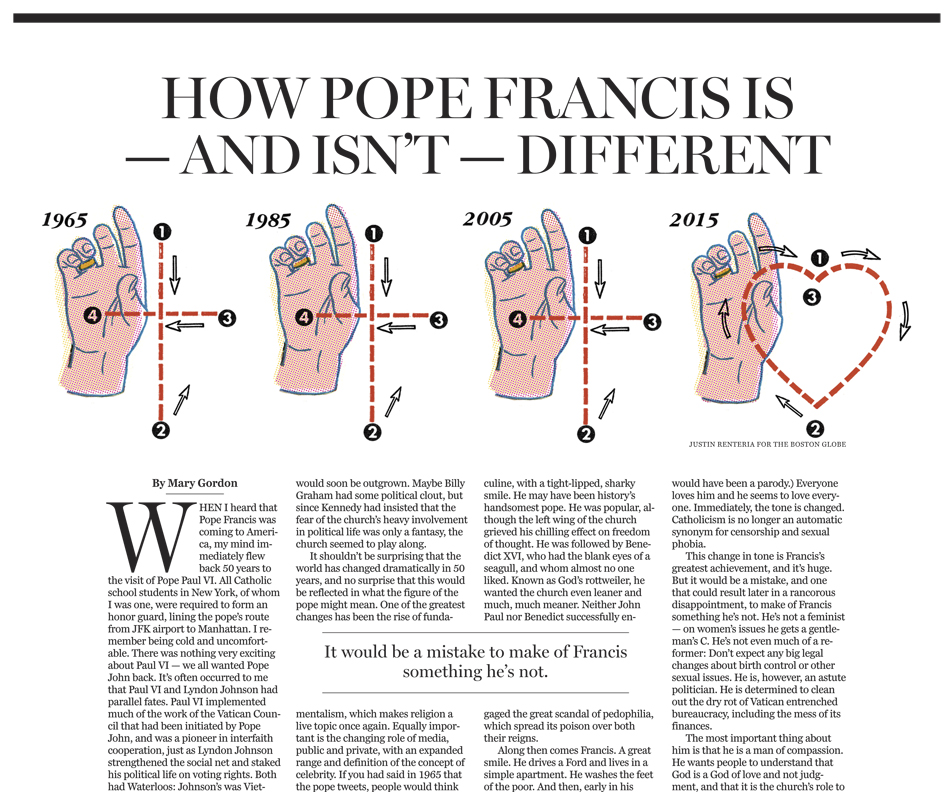
Trying to catch up on posting a few things. Here's a somewhat recent piece I did for the Boston Globe Op-Ed section. This was about Pope Francis' upcoming (at the time it was published) visit, and how he differs from Popes of the recent past:


My immediate, and ultimately most successful idea was to show the three previous Popes' hand blessing someone/making the sign of the cross. But Francis' would be making a heart shape. It came from focusing on the following passage from Mary Gordon's piece: "The most important thing about him is that he is a man of compassion. He wants people to understand that God is a God of love and not judgment..."

Thank you to Nathan Estep, AD!

Monday, July 27, 2015

Eraserhead

In heaven, everything is fine. This here piece was out in the Sunday Boston Globe a couple weeks back. It's for the review of the new Jesse Ball book, "A Cure For Suicide." Not quite a dystopian novel, but the story features a society that is definitely alien to us. War and prisons have been eradicated, but suicide still persists. The society's answer is a process that completely erases the suicidal's memory. Not just the memories that involve the reasons for the individual wanting to take his/her life, but clears the whole slate. Much like a baby, the individual must then re-learn how to talk, eat, and function as a person.


And here's the page from the Sunday Globe:


Thank you to Greg, my AD on this!

Monday, February 2, 2015

In Putin's Russia, stock market crashes YOU

Here's another book review illustration, this time on Bill Browder's Red Notice. It ran in this past weekend's Sunday Globe.


The book is the true story of Browder's experiences in Russia, after renouncing his American citizenship and traveling to Eastern Europe and Russia after the Berlin Wall fell, and once public (state-owned) services, infrastructure, and resources were being gobbled up by oligarchs, creating a huge windfall of moolah for a select few. Luckily for Browder, he was able to take advantage of some of this free-market frenzy, and after starting Hermitage Capital, rode the tumultuous wave of the stock market in Moscow, starting with $25 million, climbing to $1 billion, crashing a couple times, and ending back on top with $4.5 billion. But so this is where the story gets interesting, as Browder is detained, expelled from Russia, and basically stripped of his own company, apparently at the behest of Vladimir Putin himself. He's even convicted in absentia of tax evasion. When he tries to fight back, his tax lawyer Sergei Magnitsky is arrested, and later found beaten to death in his cell. The book is billed as a high-drama story of the ruthless corruption present in Putin's Russia, as well as Browder's crusade for justice- not only for the financial persecution he suffered, but for Magnitsky's murder as well. 


My sketches started off with fairly straight forward portraits of Putin, but I tried playing with a fever chart, and noticed how a couple crashes in the market could easily become bloody fangs on the ex-KGB man. Thank you to my AD, Kim! Here's the review.

Friday, December 5, 2014

Treat Us Like Dogs and We Will Become Wolves

I usually try (unsuccessfully) to come up with a clever title for my blog posts, but I've done a couple book reviews recently for novels with such cool titles that I decided to feature the book titles instead. Case in point: Treat Us Like Dogs and We Will Become Wolves, by Carolyn Chute. What a sweet title!


This was another review in the Boston Globe, in this past Sunday's paper. As with my post for The Laughing Monsters, I'd advise you to read the review, or better yet, the actual book, but I'll try to give a short description. The book takes place in rural Maine, in the fictional town of Egypt. Ivy Morelli, a reporter for the local paper, is investigating a strange and secretive compound called the Settlement. "It’s a cult, the residents whisper. There are pregnant child brides and child abuse, and even worse, a violent militia is stockpiling weapons, and who knows to what end? But are the stories true?" The group maintains that their aim is to provide an alternative community to the poor and outcast, away from the greed and lust for power in greater society. The charismatic leader Gordon St. Onge seems to convince Ivy that all is well, and she joins the Settlement. But a 15-year-old girl named Bree joins the group as well, and as the review explains, "It’s Bree who will cause a tsunami among the Settlement and the outsiders, one that will change just about everything for just about everyone — and not always in the best of all possible ways."


With my original set of sketches, I wanted to reference the stockpiling of weapons, but also the antagonistic stance of the Settlement toward the greed of society. In #1 and #3 I was trying to show Gordon's relationship with the women in the group- he apparently had twenty-odd wives constantly following him around.


 The editor felt it was too geared toward the "militia" themes, but also wanted the texture of the setting to come through in the illustration. Dirt roads, old wood, etc. I thought it might be a good solution to show the texture as planks of wood for a fence or wall around the compound, leaving peepholes exposing themes from the story: stockpiling weapons, Gordon's apparent stance toward society, and the red-haired Bree. It allows for multiple elements of the novel to be shown, without getting too complex, and implies the secrecy and enigmatic nature of the Settlement. The varying styles of collage also helped to connect to the novel, because it's constructed through multiple narrators, including not only the human characters, but Television, Mammon, and even aliens. Based on this review, and others, it sounds like a great book. Thank you to Kim for the assignment!

Tuesday, November 11, 2014

The Laughing Monsters

I was commissioned last week to do an illustration for the book review of The Laughing Monsters, by Denis Johnson. The piece appeared in the Boston Globe over the weekend. I only got a few lines from the review, so I had to find other reviews and synopses of the novel to get a clearer picture of what the book was really about. I won't go too far in depth (better to read the actual review, or better yet, read the book), but basically the main character, Roland Nair, works for NATO and is sent into West Africa to locate an old anti-terrorism buddy of his, Michael Adriko. The review describes Adriko thusly: "A native of Congo who has ended up affiliated with the US Army by way of Ghana, Michael is a figure cloaked in so many lies, mysteries, and identities that the novel makes little effort to render him 'believably...'" From what I could gather reading as many reviews as I could find, the main themes of the novel seemed to be ever-changing loyalties, enigmatic identities, and the relationship between these two characters- one driven by greed and power, the other seemingly nothing more than a thirst for chaos. I had one firm idea hit me early on, and turned in only one sketch, however I was pretty confident it would work. Luckily it was well received and I was able to proceed with the final:


Following along with the themes I could surmise, I wanted the identity of the figure to be obscured- it also worked out that scribbling over the face with a black pen looked like a ski mask/balaclava. The characters make their money in this world of rebels and terrorists, not always in opposition to them. The Boston Globe review can be found here.


(I did not make the cover illustration above) It seems like a really intense and intriguing novel, and the illustration was a lot of fun to work on. Thank you to Kim, the AD on this!

Thursday, February 13, 2014

Why? Why was I programmed to feel pain?

This piece appears in today's Op-Ed section of the Boston Globe. The article discusses the growing phenomenon that views robots as beings worthy of our empathy. There are citizens waiting for the moment that robots are given artificial intelligence, in order to introduce legislation protecting them, as well as a thriving sexbot industry in some countries.


 People aren't even waiting for robots to become sentient through AI, before forming bonds with them. The story mentions soldiers that served with IED-detecting robots in Afghanistan, that become attached to their mechanical comrades, and a study that shows how reticent people are to "harm" toy robots that they've been given. It's a really interesting article, you can read it here with a subscription.


Thank you to Corinne!
Also, I couldn't help thinking about a Simpsons episode when reading this story:


It's the one where Lisa finds an "angel" on her school archeological dig.

Monday, July 22, 2013

What we do is secret

This piece for the Boston Globe's Sunday Op-Ed section was a really quick turnaround. Last Wednesday afternoon/evening, basically. The op-ed is about the Senate meeting that took place out of view of the public, behind closed doors, at night. And something was actually accomplished! The GOP agreed to confirm Obama's appointees for various posts, in exchange for the ability to filibuster. The author suggests that transparency in politics may not be such a good thing:


It's an interesting thought, and I was eager to try my hand at representing the idea visually. Here are the other sketches:


I liked the idea of showing the Capitol blurred, obstructing public view. I also tried using the "off the air" screen over the Capitol, since the meeting took place late at night, off camera- although that may have worked better had this piece been in color. The last sketch shows how the politicians' statements being redacted leads to agreement. The point of the article is that our leaders grandstand and ape for the cameras far too much for any compromise to be achieved. SOAPBOX ALERT: While I do agree that playing to the cameras, and offering sound bites instead of solutions can be extremely frustrating (and this was a meeting about confirming nominees and filibuster rules, not drafting some specific legislation), I personally disagree with the premise. It all seems so backwards nowadays. Private citizens' every electronic communication can be collected, stored and analyzed, with barely any oversight, much less a warrant, and we're expected to allow our elected officials- whom we've hired to work on our behalf- to conduct business in the dark?
Thank you to Greg and Dan for the assignment!

Monday, March 7, 2011

A brush with American consumerism

I did this piece, which was in yesterday's edition, for Josue from Boston Globe Magazine a couple weeks ago. The author describes his stint as a door-to-door vacuum salesman, in a very tongue-in-cheek assessment of American consumerism.


I really enjoyed working on this piece, not just because I thought the essay was great, but also because I got to incorporate a little photo-collage into it. I usually reserve the photo-montage for my personal work, but this assignment just seemed to beg for it. Luckily, Josue agreed. Read the story here.

Monday, February 14, 2011

Guns on campus, for the Globe.

I actually finished this illustration a few weeks ago, but it was just published in Boston Globe Magazine yesterday. The essay is written by a junior at Harvard University, who argues that students should have less, not more access to guns on college campuses.


One of the author's suggestions for trying to prevent future shooting sprees, is for colleges to alert law enforcement agencies about students that might be dangerous. Shining a light on troubled individuals might help the public be more proactive in preventing violent outbursts, such as the recent shooting in Tucson. You can read the essay here. Josue Evilla commissioned me for the job, and it was great working with him again.

Monday, October 25, 2010

NY Times Op-Ed Piece

I got a call from Alexandra Zsigmond from the NY Times last week, to do a quick illustration for the Op-Ed page. My piece accompanied the letters in yesterday's Sunday Times, responding to a recent article on the culture of poverty. Alexandra thought it would be best not to focus on the roots of poverty, but instead show the struggle to escape it. Read the responses here. Thank you again, Alexandra.


I also had an illustration in the Boston Globe Magazine last weekend. The article's author, a Republican, is torn between supporting her party and her best friend, who is running for office as a Democrat. I worked with Grant Staublin on this job. Thanks, Grant!